HVAC Refrigerants in Miami-Dade — What You Need to Know
The refrigerant inside your AC system is changing. R-410A — the standard refrigerant for the past two decades — is being phased out under federal regulations. New systems use R-454B and other lower-GWP alternatives. Rocket HVACR handles refrigerant transitions, leak repairs, and eco-friendly system installations across Miami-Dade.
- R-410A and R-454B system service
- Refrigerant leak detection and repair
- Eco-friendly refrigerant installations
- Licensed Florida HVAC contractor — CMC1251543
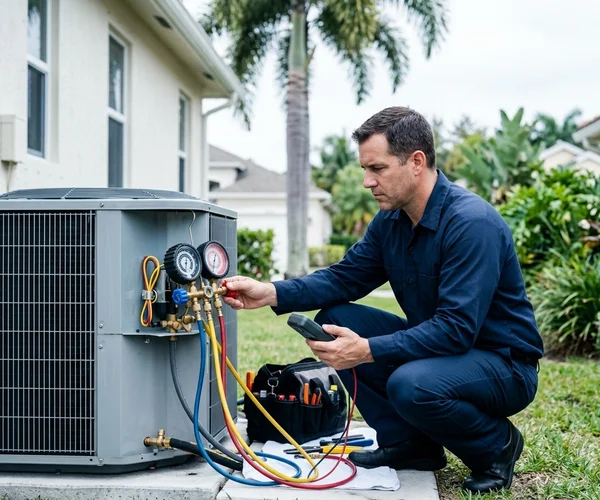
The Refrigerant Transition: What Miami Homeowners Need to Understand
Refrigerant is the chemical compound that makes air conditioning possible — it absorbs heat from indoor air at the evaporator coil and releases it outside at the condenser. For two decades, R-410A was the standard refrigerant in residential HVAC systems. As of January 1, 2025, new residential AC equipment manufactured for the U.S. market must use refrigerants with significantly lower global warming potential (GWP) — primarily R-454B.
This transition affects homeowners in two ways. First, if you are buying a new HVAC system, it will use a newer refrigerant. Second, if your existing R-410A system needs refrigerant service, the cost and availability of R-410A will change as production is phased down under the AIM Act. Understanding where your system stands helps you make better decisions about repair versus replacement.
Rocket HVACR is current on both R-410A service for existing systems and R-454B equipment for new installations. Our engineers understand the technical differences between refrigerant families and can advise based on your system's age, condition, and your long-term goals.
Why the Refrigerant Transition Matters for Your Home
-
Environmental Improvement
R-454B has 78 percent lower global warming potential than R-410A, reducing the climate impact of refrigerant releases during service events and at system end-of-life.
-
Regulatory Compliance
New residential equipment must use low-GWP refrigerants under federal AIM Act regulations. Understanding compliance requirements protects your system investment.
-
Long-Term R-410A Availability
R-410A production is being phased down. Homeowners with existing systems should understand how this affects service costs over the remaining life of their equipment.
-
Informed Repair vs. Replacement Decisions
A refrigerant leak in an aging R-410A system raises a different cost calculation than it did three years ago. Rocket HVACR provides honest advice on whether repair or replacement makes more financial sense.
Our Refrigerant Services
Handling both legacy and new-refrigerant systems across Miami-Dade.
Refrigerant Leak Detection
Electronic leak detection identifies refrigerant leaks precisely — at coil connections, service valves, brazed joints, and within the coil itself.
Leak Repair
We repair refrigerant leaks at the source rather than simply adding refrigerant to a leaking system — which is not a repair, only a delay.
Refrigerant Recharge
After leak repair, systems are recharged to the manufacturer's specified refrigerant weight. Proper charge is critical to system efficiency and compressor life.
R-454B System Installation
New system installations use R-454B or other AIM Act-compliant refrigerants. We specify and install equipment that meets current federal and Florida requirements.
Refrigerant Transition Guidance
If your existing R-410A system needs significant refrigerant work, we advise on the repair-versus-replace decision with current refrigerant availability and cost data factored in.
System Commissioning
After any refrigerant service, we verify superheat and subcooling values to confirm the system is operating at proper charge — not just adding refrigerant by pressure.
How Rocket HVACR Handles Refrigerant Service
Precision refrigerant work from an engineering-grade contractor.
- 1
System Diagnosis
We diagnose the refrigerant circuit — checking pressures, temperatures, superheat, and subcooling — to determine whether a charge issue or leak is present.
- 2
Leak Detection
If a leak is indicated, we use electronic leak detectors to locate the precise point of refrigerant loss before recommending repair.
- 3
Honest Repair vs. Replace Recommendation
We evaluate the system's age, condition, refrigerant type, and repair cost against replacement cost — and give you an honest recommendation, not just a bill for more refrigerant.
- 4
Repair and Recharge
Leak repairs are made to the identified failure point. The system is recharged by weight to manufacturer specification and verified by superheat and subcooling measurements.
- 5
System Performance Verification
After refrigerant service, we confirm the system is achieving proper temperature differential and operating within specification before closing the job.
What Miami-Dade Clients Say
"My system was low on refrigerant every year. Three different companies kept charging it without finding the leak. Rocket used electronic leak detection, found a pinhole at the evaporator, repaired it, and recharged correctly. Two years later, still holding charge."
Robert N.
"When my 12-year-old R-410A system developed a refrigerant leak, Rocket gave me an honest comparison of repair cost vs. replacement cost with current refrigerant pricing factored in. They did not push me either way — just gave me the numbers. I chose replacement and I'm glad I did."
Diana C.
"First HVAC company I've worked with that checked superheat and subcooling values after adding refrigerant instead of just going by pressure. That kind of technical rigor is exactly what aerospace-trained engineers should bring to this work."
Marco V.
Understanding the R-410A to R-454B Transition
What the AIM Act Means for Homeowners
The American Innovation and Manufacturing (AIM) Act of 2020 directed the EPA to phase down production of high-GWP refrigerants including R-410A. As of January 1, 2025, new residential and light commercial HVAC equipment manufactured for the U.S. market must use refrigerants with a GWP of 750 or below. R-410A has a GWP of 2,088 — well above the new threshold. R-454B has a GWP of 466.
This does not mean R-410A systems are illegal to own or service — existing systems can continue to be serviced with R-410A as long as the refrigerant is available. However, as production is phased down, supply tightens and prices rise. Homeowners with aging R-410A systems facing significant refrigerant work should factor refrigerant cost trends into their repair-versus-replace decisions.
Rocket HVACR advises on these decisions with current pricing and availability data. Our recommendation is always grounded in the homeowner's best financial interest — not in pushing a new system sale when a repair is genuinely the better option.
R-454B Safety and Handling Considerations
R-454B is classified as mildly flammable (A2L under ASHRAE safety classification) — a designation that distinguishes it from non-flammable R-410A. A2L refrigerants require modified handling procedures, specific leak detection protocols, and equipment designed for use with mildly flammable refrigerants. New equipment sold in the U.S. market after January 1, 2025 is designed for R-454B and includes the safety features required for A2L refrigerants.
For homeowners, the practical implication is that R-454B systems require service by technicians trained and equipped to handle A2L refrigerants. Rocket HVACR technicians are trained on A2L handling protocols and use equipment appropriate for R-454B service — a requirement that not all contractors in the market have met as of the transition date.
Refrigerant Questions — Answered
Related Resources
-
Eco-Friendly Refrigerants
R-454B and other low-GWP refrigerant options for environmentally conscious Miami homeowners.
-
R-454B Upgrade Guide
What upgrading from R-410A to R-454B equipment actually involves.
-
R-410A vs R-454B Comparison
Side-by-side comparison of R-410A and R-454B refrigerant characteristics.
-
AC Repair
AC repair services including refrigerant leak diagnosis and repair across Miami-Dade.
-
AC Installation
New AC system installations using current R-454B equipment — properly sized and permitted.
Refrigerant Issue? Get an Honest Diagnosis from Rocket HVACR
Whether your existing system needs a leak repaired or it is time to evaluate replacement options, Rocket HVACR gives you accurate information and honest recommendations. Call for same-day or scheduled service.
Schedule ServiceOr call us directly: (786) 716-1245